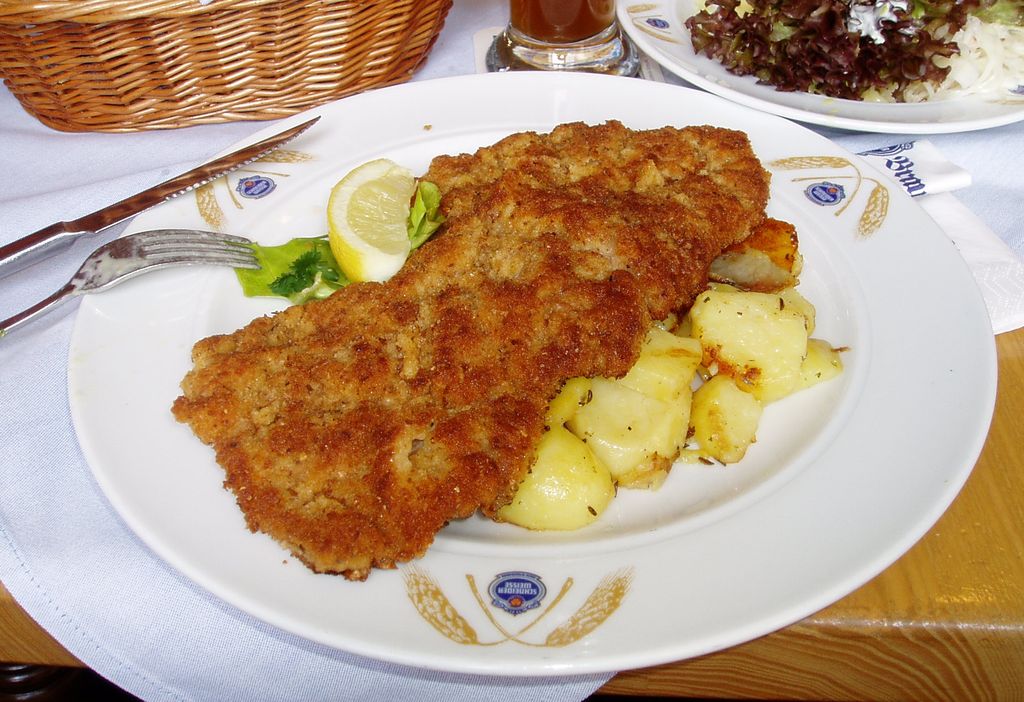
A thin, crisp veal cutlet so central to Viennese identity that Austrian law restricts what may be sold under the name.
A legend worth correcting
A charming story claims that a nineteenth-century Austrian field marshal brought the breaded cutlet back to Vienna after campaigning in Milan, where a similar dish is a local speciality. The tale is repeated constantly and appears to be an invention of the twentieth century, with no contemporary evidence behind it.
The likelier explanation is less dramatic. Breading and frying meat was practised in several European cuisines well before the supposed transmission, and Vienna developed its own refined version within that broader tradition. The Milanese and Viennese cutlets are relatives rather than parent and child.
In Austria the name is legally protected. A dish sold as Wiener Schnitzel must be veal; the very common and much cheaper pork version has to be labelled differently, usually as Schnitzel Wiener Art, meaning Viennese style.
Thin, dry and blistered
The cutlet is pounded until very thin, which tenderises it and ensures it cooks through in the moments before the coating burns. It is seasoned, then passed through flour, beaten egg and fine breadcrumbs.
The crucial detail is that the coating must not be pressed on. Left loose, it puffs away from the meat during frying and forms the characteristic blistered, wrinkled surface that separates a proper schnitzel from a flat, tight crust.
It is fried in generous fat — traditionally clarified butter or lard — in a pan swirled continuously so hot fat washes over the top. That motion is what makes the coating billow. The finished schnitzel should be pale gold, dry to the touch, and large enough to overhang the plate.
At the table
It is served simply: a wedge of lemon, and traditionally a potato salad dressed with vinegar and stock rather than mayonnaise, sometimes with lingonberry jam alongside. Sauce is not part of the tradition and would defeat the point of the crust.
In Vienna it remains an everyday restaurant staple as much as a tourist dish, and the older establishments that specialise in it are judged on details invisible to outsiders: the quality of the veal, the freshness of the frying fat, and whether the coating has that essential blistered lift.